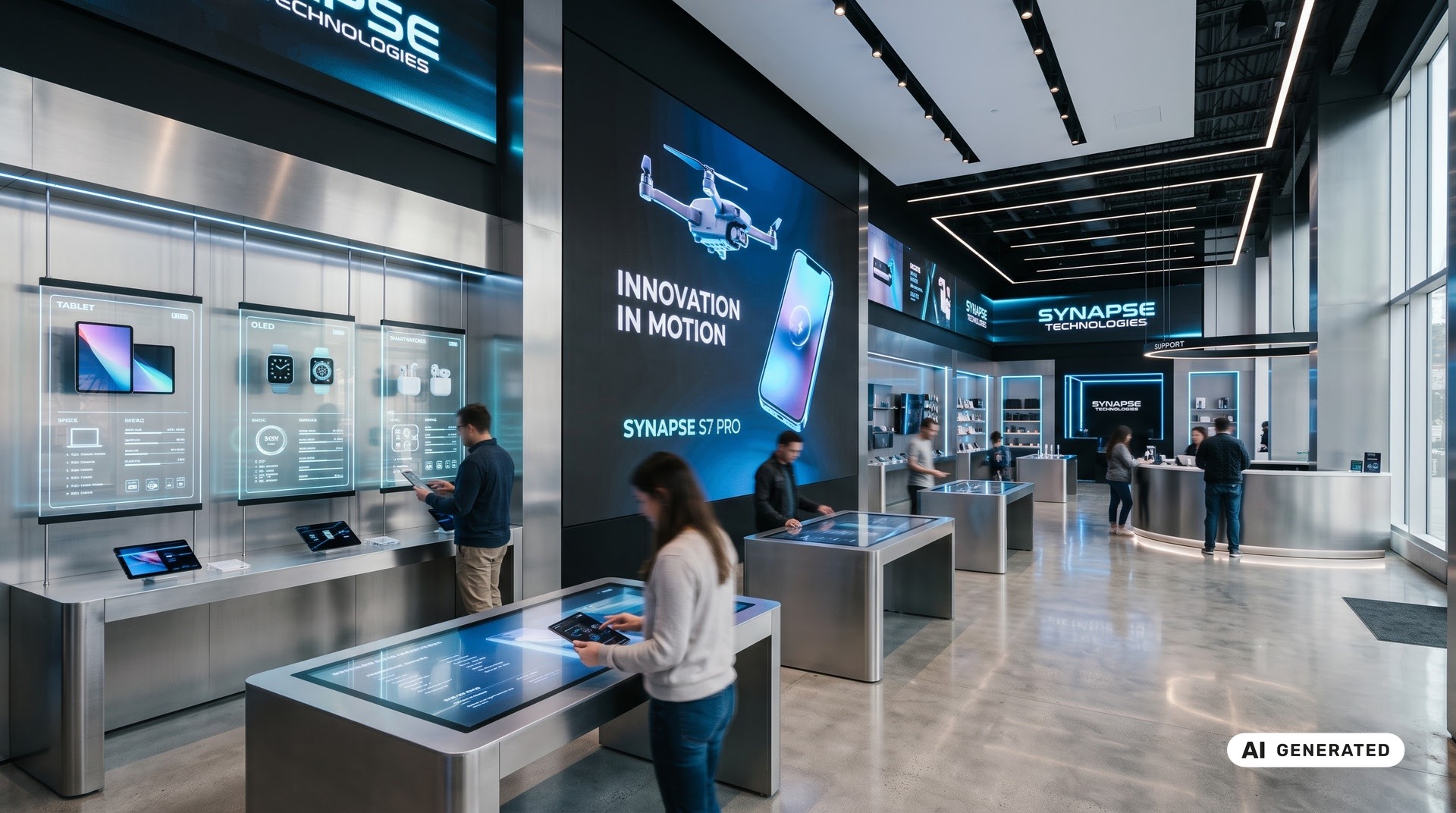
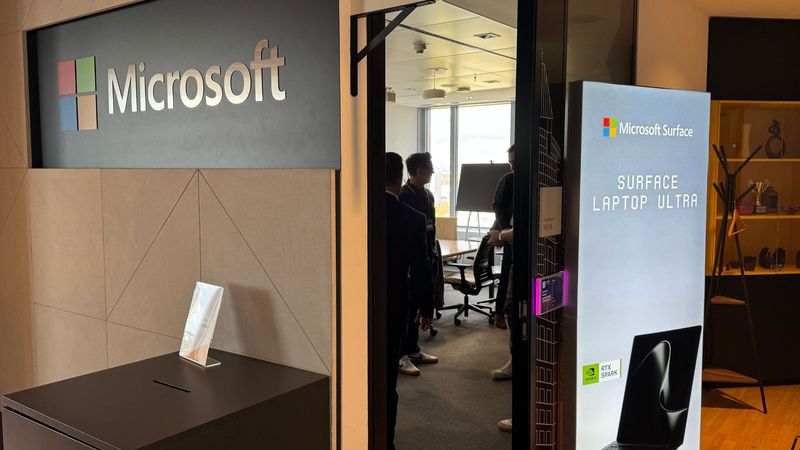
Digital showrooms and experience centers. Brands you can walk into.
B2B products that need explaining sell in a room, not in a PDF. We design and build interactive showrooms, experience centers and executive boardrooms — including the LED wall, touch control and the content that runs on it.
Wednesday, 10 a.m. The quarter’s most important customer walks in.
Products that need explaining sell in a room, not in a PDF. This is where it is decided whether the room helps sell, or the salesperson has to explain everything alone.
10:00
The first impression
In a generic meeting room nothing carries the story. Salespeople compensate by talking more, and the presentation drags.
10:20
The room tells the story
LED wall, touch stations and loop content are tuned to the flow and dwell time of the visit. The salesperson leads, the room provides the proof.
11:30
The impression stays
The presentation has become shorter and stronger. And every further tour runs equally well, even with a different host.
1
team for concept, build, content and operation
1:1
content produced for the real pixel matrix, not scaled
Central
one CMS: content by time of day, season and range
1 touch
to start the executive boardroom
Use Cases
Concrete, not abstract: four cases from practice.
Every case with a clear challenge, a clear solution and a measurable outcome.
01 / 04
Sales demo room for products that need explaining
Challenge
Complex B2B solutions get presented in generic meeting rooms. The room doesn't carry the story — sales reps compensate by talking more.
Solution
A demo room designed around how people move through it: content, technology and visitor flow work together. The presentation gets shorter and stronger.
Outcome: Shorter sales cycle thanks to a stronger first impression
Product videos and promotions on the sales floor are outdated because updating them is decentralized and tedious. Promotions simply keep running after they have ended.
Solution
A central CMS: content by time of day, season and product range, played out automatically, location-specific and always current.
The more a product needs explaining, the worse a catalog works. A machine that stands
four meters tall, software that gives nothing away in a screenshot, a material whose
advantage has to be seen: in these cases the room is the better sales tool. A
digital showroom makes the unshowable showable.
Planning an Interactive Showroom for B2B Sales
A showroom is not an exhibition space with screens, but a conversation tool. Planning
therefore doesn't start with the technology, but with the flow: Who is coming, how long
do they stay, at what point is the decision made, and what should they tell others
afterwards? From this script come the stations, dwell times and only then the floor space
and technology. The detailed guide:
Planning a showroom. On costs:
What does a showroom cost?
Experience Center: AV Technology Agency from Bavaria
Reception with brand wall
An experience center goes beyond the showroom: several zones, staged dramaturgy,
often several hundred square meters and operation over many years. Alongside design,
what counts above all is operability. A space that doesn't start up on its own in the
morning, or whose content nobody can change after two years, is an expensive standstill.
We plan zone logic, control and content maintenance together and, if you wish, take over
operation under a service contract. For context, see the glossary:
Experience Center; for a cost range, see
What does an experience center cost?
LED Wall Solutions for Brand Spaces
In a brand space, an LED wall is almost always the right choice: it is seamless,
bright enough for daylight and free in shape. What matters is the pixel pitch in relation
to the viewing distance: someone standing two meters away needs a finer matrix than for a
stage surface. The trade-offs against projection and LCD are explained in
LED video wall or projector?
and LED video wall or LCD video wall?
Equally important is the content: content for an LED surface is produced for its actual
pixel matrix, not scaled up from a 16:9 video. See
Content Creation.
High-Quality AV Technology for the Executive Boardroom
The boardroom is the room where technology should be noticed least and has to work
most reliably. Guests at board level don't operate menus. We build these rooms with
control that starts at the touch of a button, with audio that stays intelligible even at
the head of the table, and with camera tracking that doesn't turn remote participants
into second-class spectators. More at
Creative AV Spaces and
Boardroom.
Frequently Asked Questions
What does an interactive showroom cost?
A compact showroom with one large display surface, a touch station and control starts in the mid five-figure range. Multi-zone experience centers with staged dramaturgy, several LED surfaces and custom-produced content are clearly in the six-figure range. The largest single item is usually the LED surface; the most frequently underestimated one is the content.
LED wall or projection in the showroom?
In rooms with daylight or high ambient brightness, the LED wall is almost always superior: no shadows cast, no darkening, constant brightness over years. Projection remains sensible for very large surfaces with controllable lighting, or when the surface is only needed occasionally.
Who produces the content for the surfaces?
We do, in the same project as the technology. This is not an add-on but a necessary prerequisite: content for an LED surface must be produced for its actual pixel matrix and aspect ratio. A scaled 16:9 video does not yield a usable image on a custom-shaped surface.
How long does it take to implement a showroom?
From the first concept sketch to opening, four to eight months is realistic, depending on construction work and the scope of the content. The technical installation itself is the shortest part; concept, coordination and content production take up the larger share.
Adjacent Areas
It's rarely just one department.
A space lives on content, operations and a network that keeps it running.